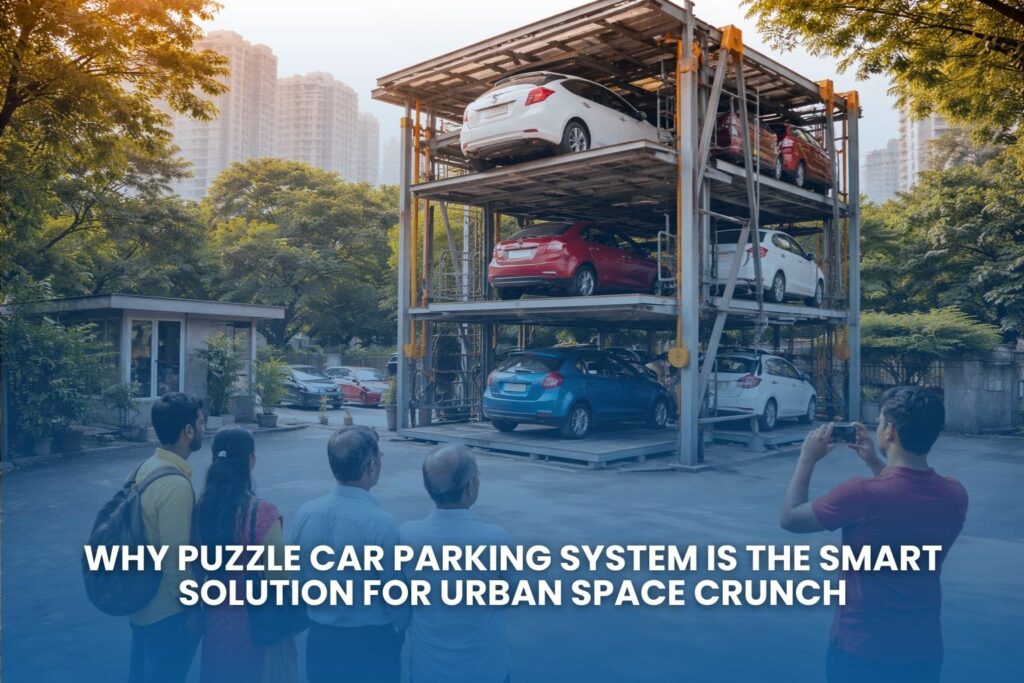
Urban India is growing vertically, but our parking infrastructure is still struggling to catch up. In dense cities like Mumbai, every square foot carries a premium. Residential towers, commercial complexes, hospitals and retail hubs are competing for limited land and parking has become one of the biggest design and operational challenges. Traditional surface parking and even conventional basement layouts are no longer sufficient. This is where the puzzle parking system emerges as a practical, space-efficient and future-ready alternative.
The Urban Parking Crisis
Rapid urbanization has significantly increased vehicle ownership. In cities such as Mumbai, where land scarcity defines real estate economics, accommodating cars within limited plot sizes is complex. Developers are under pressure to provide adequate parking to meet municipal norms while also maximizing sellable or usable area.
Conventional ramp-based parking consumes substantial circulation space. Wide driveways, turning radii and multiple levels increase construction costs and reduce efficiency. In contrast, a multi level car parking system based on automated or semi-automated technology can multiply parking capacity within the same footprint.
What Is a Puzzle Car Parking System?
A Puzzle Car Parking System is a semi-automated mechanical parking solution that operates on a grid-based movement pattern. Vehicles are parked on platforms arranged in rows and columns. Through horizontal and vertical movements, the system shifts platforms like pieces of a puzzle to create an empty slot at ground level for vehicle entry or exit.
Unlike stack parking systems where cars are vertically lifted one above another in a fixed column, a mechanical puzzle parking system allows independent access to multiple vehicles without needing to remove others first. This flexibility is a major operational advantage in high-density developments.
How It Solves the Space Crunch
1. Optimal Land Utilization
A puzzle parking system significantly increases parking density. By eliminating ramps and reducing drive aisles, it maximizes the use of available basement or stilt area. In tight urban plots, this translates to a higher number of parking slots within the same built-up area.
For developers in regions like puzzle parking system mumbai projects, this efficiency can directly impact project feasibility. More parking within limited space means better compliance with regulations and improved buyer satisfaction.
2. Flexible Configuration
One of the strengths of a Puzzle Car Parking System is modular design. It can be configured in 2-level, 3-level or even higher arrangements depending on ceiling height and site conditions. The system can also be installed above ground, in basements or partially below grade.
This flexibility makes it suitable for:
- Residential societies
- Commercial office buildings
- Shopping malls
- Hospitals
- Redevelopment projects
3. Reduced Construction Costs
While mechanical systems involve an initial investment, they often reduce overall civil construction costs. Eliminating long ramps, extensive excavation and heavy structural reinforcement for vehicular movement lowers the structural load requirements.
Compared to constructing multiple basement levels, installing a multi level car parking system based on puzzle technology can be more economical in constrained sites.
4. Improved Safety and Security
Since vehicles are parked on designated platforms and there is minimal human intervention inside the parking grid, risks of scratches, dents and unauthorized access are reduced. The system operates through control panels or smart access cards, ensuring regulated usage.
Additionally, fewer moving vehicles inside basements mean lower risk of accidents and better pedestrian safety.
Operational Efficiency in High-Density Cities
In a city like Mumbai, where time and space are equally valuable, efficiency matters. The mechanical puzzle parking system is designed for smooth and relatively quick vehicle retrieval. Modern systems integrate sensors, PLC controls and safety interlocks to ensure precise platform movement.
For residential complexes with peak-hour parking demand, this system minimizes waiting time compared to traditional stack parking, where one vehicle may block another.
Environmental Advantages
Urban planning today must consider sustainability. Puzzle parking systems contribute in several ways:
- Reduced idling time while searching for parking.
- Lower fuel consumption within parking areas.
- Optimized land use, allowing more green or recreational spaces at ground level.
- Potential integration with electric vehicle (EV) charging points.
By reducing the need for large surface parking areas, developers can allocate more area to landscaping and community amenities.
A Smart Investment for Developers
Real estate economics in cities like Mumbai are tightly calculated. Every square foot saved or optimized contributes to higher returns. Installing a puzzle parking system allows developers to:
- Increase parking capacity without expanding the footprint.
- Enhance property value.
- Meet municipal parking norms efficiently.
- Offer premium parking solutions as an added amenity.
Homebuyers today are more aware and value structured, technology-driven parking solutions over congested, poorly managed basements.
Choosing the Right Car Parking System Manufacturers
The performance of a Puzzle Car Parking System depends heavily on engineering quality, safety standards and after-sales support. Reliable car parking system manufacturers provide:
- Structural design validation.
- Compliance with local safety codes.
- Anti-corrosion treatment for long durability.
- AMC (Annual Maintenance Contracts).
- On-site technical support.
In coastal cities like Mumbai, corrosion resistance and long-term durability are critical factors due to humidity and saline air. Selecting an experienced manufacturer ensures that the system remains reliable over years of operation.
Future of Urban Parking
As Indian cities continue vertical expansion, mechanical parking will shift from being a luxury feature to a necessity. Land scarcity, rising vehicle ownership and stricter regulatory frameworks will accelerate adoption of automated and semi-automated solutions.
The Puzzle Car Parking System represents a balanced middle ground between fully automated robotic parking and basic stack systems. It offers scalability, cost-efficiency and operational reliability making it particularly suitable for mid-to-high-rise developments in dense urban cores.
Urban space is limited, but smart engineering can multiply its potential. The puzzle parking system stands out as a practical, efficient and scalable solution to the growing parking crisis in metropolitan cities. By optimizing space, improving safety and enhancing project value, it addresses one of the most pressing infrastructural challenges of modern urban development.
For cities like Mumbai, where every square foot matters, adopting mechanical puzzle parking is not just an upgrade it is a strategic necessity.